Under the Mask
On the masks we wear to earn love - and the closeness we lose behind them.
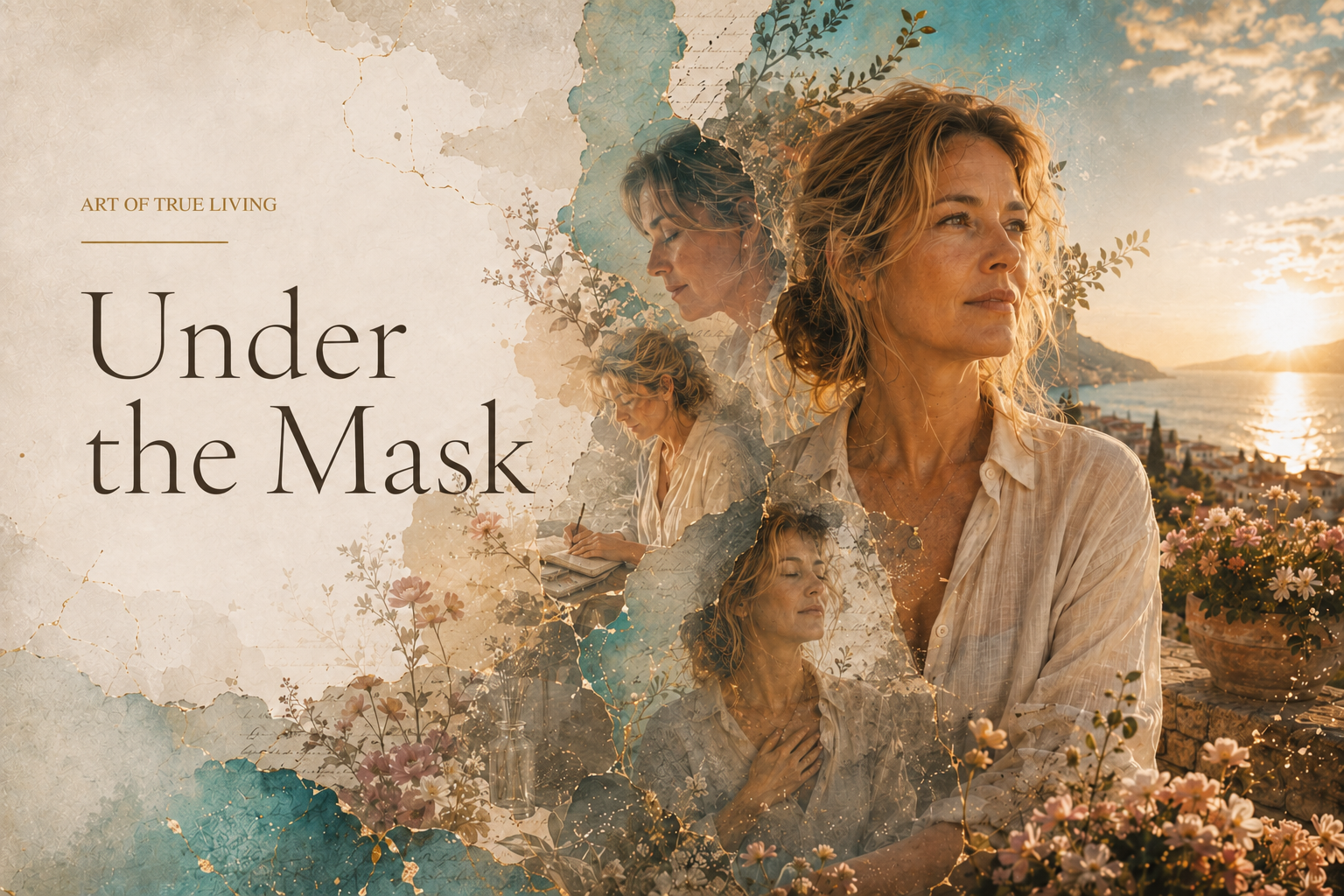
The inspiration for writing my song “Under the Mask” came from the show “Love Is Blind”.
Yes, I know - a reality show is hardly where we expect to find answers to the most important questions about love and closeness;) And yet I was deeply curious about what happened to the participants when their conversations through a wall, their first declarations and their imagined versions of one another met everyday life.
That was when patterns began to surface that had previously been hidden behind beautiful words. One person would pull away when closeness became too real, afraid of being hurt, losing their independence, or being seen as they truly were and then abandoned. The other, sensing the growing distance, would try even harder to hold on, because that distance awakened their fear of abandonment.
The more one pulled away, the harder the other tried to get closer. The harder they tried, the more pressure the first person felt.
Watching them, I thought about two people who essentially want the same thing - to love and be loved - yet each tries to manage their fear in a completely different way.
From the outside, it may look as though one person does not want closeness while the other wants it at any cost. Beneath these opposing behaviours, however, a similar fear may be hiding: if I truly show myself, someone will decide that I am impossible to love.
And it was this observation that gave rise to the question that later found its way into the song:
Can I be loved as I truly am?
Not just for what I can do for another person. Not for being strong, resourceful, responsible and understanding, or for enduring a great deal, carrying even more, and usually finding a way to cope.
Me.
For a long time, I thought masks were mainly worn by people pretending to be someone they were not. Today, I see them differently, because a mask is not always a lie. Sometimes it is a way we have learned to move safely through the world.
It may take the form of strength, independence, calm or reason. Sometimes it shows up as an endless willingness to understand others, taking on yet more responsibilities, or saying “It’s nothing”, even though something happened and is still alive inside us.
It can also mean setting the bar so high for ourselves that there is barely any room left for weakness, exhaustion, or a simple “I can’t do this”.
For years, I demanded a great deal of myself. I was supposed to be responsible, strong, resourceful and dependable, and when things got hard, I was supposed to try even harder.
For a long time, I saw these qualities only as strengths, and I still know how much I achieved because of them. I can take action, accept responsibility and cope in situations where others would have given up long before. The problem began when I gave myself no choice. I had to be that way all the time, because somewhere deep down I believed that this was how I would earn love.
That did not mean I asked little of my partner. Quite the opposite. Since I gave so much of myself, I expected him to make an effort too, take responsibility, and meet standards that seemed obvious to me.
Only years later did I see that the demands I placed on him probably grew out of the same exceptionally high demands I placed on myself. The more I did to earn love, the more clearly I saw everything the other person was not doing.
In this way, I was also building up my own “fucking amazingness” at his expense.
Since I saw myself as the one who handled everything, remembered, anticipated and took responsibility, it became increasingly easy to see him mainly in terms of what he did not do, or what he did not do the way I would have done it.
I was not doing this consciously or calculatingly. I genuinely believed I was simply loving, supporting and giving my all. Over time, however, my efforts also gave me a sense of moral superiority, even though I would have been utterly unable to admit it then.
After my divorce, I saw something that was painful and uncomfortable for me. My self-sacrifice had not always been entirely selfless. Sometimes an unspoken agreement lay beneath it:
Since I am so good to you, love me more.
There was also an expectation:
Since I am trying so hard, you should too.
The terms of this agreement were never spoken. They could not have been, because even I was not fully aware of them.
Yet I hoped that by giving so much and trying so hard, I would become someone who could not be rejected. I also expected my efforts to be returned in exactly the way I needed.
When that did not happen, I felt disappointed and angry. It seemed to me that I was giving far more than I received, without yet seeing that some of my giving was not a free choice at all. It was an attempt to secure the relationship and receive the love I did not know how to ask for directly.
I said “yes” when I felt “no”, explained away behaviour that hurt me, and shifted my own boundaries, then suffered because someone did not notice them. At the same time, I expected the other person to work out for themselves how much it cost me, appreciate my efforts and respond in kind.
I wanted to be loved for who I was, but mostly showed the version of myself that I believed had the best chance of being loved. Strong, capable, understanding, and ready to carry more than she truly wanted to.
And perhaps that is precisely the paradox of the mask.
We put it on because we fear rejection. But when someone stays, we cannot be sure whether they have fallen in love with us or with the person we have learned to be around them.
A mask may therefore reduce the risk of rejection, while at the same time distancing us from the closeness we long for most.
Of course, this does not mean we should immediately tell everyone everything, reveal every wound and abandon all protection. Not every relationship is safe, and not everyone can receive our truth. Authenticity is not about exposing ourselves emotionally to every person who crosses our path.
But before we show someone what lies beneath the mask, we must first have the courage to look there ourselves.
To recognise what we truly want and where our boundaries lie. To see when we give out of love, and when we try to use our giving to secure another person’s love. To admit to ourselves that an expectation may hide behind self-sacrifice, even if we have never voiced it.
These days, I increasingly feel that taking off the mask does not mean getting rid of the fear of rejection. It is more about not abandoning myself under the influence of that fear every time there is a risk that someone else might leave.
The song “Under the Mask” ends with a question that remains, for me, one of the most important questions about closeness:
Am I willing to be who I truly am, even when it gives me no guarantee that I will be chosen?
You can listen to it here: Under the Mask - Spotify
Closeness without abandoning yourself
Sometimes we already understand why, in relationships, we become strong, dependable and ready to carry more than we truly want to. It is much harder to begin behaving differently - to say clearly what we need, set a boundary, and stay true to ourselves when the other person responds with disappointment, distance or anger.
These are exactly the moments we work with in the Sovereign Woman Process. Not to learn how to choose ourselves against others, but to be with another person without continually abandoning ourselves.